I. National Admission System
The student admission process at Hasanuddin University follows the national regulations of the Ministry of Education, Culture, Research, and Technology of the Republic of Indonesia. The most relevant legal basis is Ministerial Regulation No. 48 of 2022 on the Admission of New Students to Diploma and Undergraduate Programs at State Universities, as amended by Regulation 62 of 2023. According to this regulation, there are three main admission pathways for undergraduate students:
A. National Selection Based on Academic Achievement (SNBP) This pathway is based on:
- Component 1: Average report card grades across all subjects (minimum 50% of the evaluation weight), and
- Component 2: Grades from up to two key subjects relevant to the study program, portfolio (if applicable), and/or other academic achievements (maximum 50%). The specific weight of each component is determined by the respective university, while the key subjects are set by the Ministry.
B. National Selection Based on Tests (SNBT)
This selection uses a computer-based standardized test that measures cognitive potential, mathematical reasoning, Indonesian literacy, and English literacy. This selection is conducted once a year.
C. Independent Selection by the University (Seleksi Jalur Mandiri)
Each state university may conduct its own independent selection based on academic considerations. This process must be non-commercial and transparent. Before implementation, universities must publicly announce:
- The number of students to be admitted,
- assessment methods (e.g., independent tests, consortium-based assessments, or using SNBT scores), and
- any applicable fees or fee structures. After the selection, universities must announce:
- the list of admitted students and the remaining quota,
- an objection period of five working days,
- procedures for filing objections, and
- access to the national whistleblowing channel for reporting violations during the selection process.
The technical procedures for the independent selection are defined by the leadership of each institution. Universitas Hasanuddin offers several pathways for Independent Admission (Seleksi Jalur Mandiri), including routes for outstanding achievements in academics, sports, arts, and leadership (such as OSIS Chairperson), and high-performing vocational school graduates. Additional pathways include Talent Showcase, International Class for Indonesia citizens, Affirmation programs for students with disabilities and special partnerships, Recognition of Prior Learning (RPL), the ADik Program for underprivileged regions, and international student admissions.
II. International Student Admission
Foreign students who wish to study at Universitas Hasanuddin (Unhas) can apply online through the university’s official admission portal. The process involves selecting a study program, completing a personal profile, uploading required documents, and undergoing a selection process. The selection typically includes academic and psychological assessments and an interview.
All communication, including announcements and schedules, is managed through the applicant’s online account and registered email. For any inquiries, assistance is available via email.
The link for admission information is given below:
https://dikmawa.unhas.ac.id/wp-content/uploads/2024/07/Online-ApplicationGuide-Unhas-Admission-for-Foreign-Student-R.pdf
Universitas Hasanuddin welcomes international students to experience academic and cultural life in Indonesia through non-degree programs. These programs offer a chance to study for a limited period without pursuing a full degree, making them ideal for student exchanges, internships, or short-term research.
The application begins with online registration and submitting personal information and necessary documents. Once reviewed and accepted, the university will issue an official Letter of Acceptance, which helps students arrange their visas and prepare for their journey to Makassar, Indonesia.
Throughout the process, support is available to ensure a smooth and welcoming experience for every prospective student.
The link for admission information for non-degree students is given below:
https://dikmawa.unhas.ac.id/wp-content/uploads/2024/08/Application-Guide-Nondegree-Foreign-Student-R.pdf
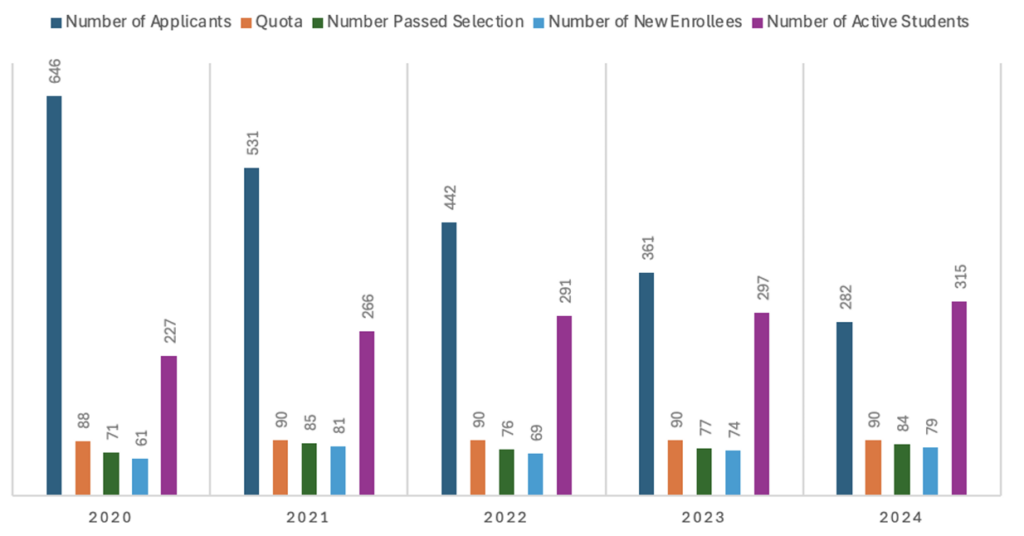
The chart presents data on new student admissions and the number of active students in the Mathematics Undergraduate Program over the past five academic years (20202024). Several key indicators are shown: the number of applicants, intake capacity, students passing the selection process, the number of new students enrolled, and the number of active students in each corresponding year.
- The number of applicants showed a decreasing trend from 646 in 2020 to 282 in 2024. Despite the decline, interest in the program remains significant compared to the intake capacity.
- The intake capacity remained relatively stable, ranging from 88 to 90 students each year.
- The number of students who passed the selection process fluctuated slightly, from 71 in 2020 to 84 in 2024, indicating consistent selectivity.
- The number of new students enrolled increased slightly in 2024 compared to 2023, reaching 79 students, which shows good conversion from selection to enrollment.
- The number of active students consistently increased over the years, from 227 in 2020 to 315 in 2024, suggesting improved student retention and academic continuity within the program.
Overall, the data reflect a stable intake management policy and a positive trend in student activity levels. There are many applicants for available seats and an increasing number of actively enrolled students across the five years.